
Exploring Upper Darby’s Underground Railroad Walking Tour
by Terrance Casey
Just minutes beyond Springfield lies a remarkable concentration of sites connected to one of the most courageous chapters in American history: the Underground Railroad.
Today, residents can explore this legacy through Upper Darby’s self‑guided Underground Railroad Walking Tour, a reflective journey across places where enslaved men, women, and children once sought freedom with the help of brave local abolitionists.
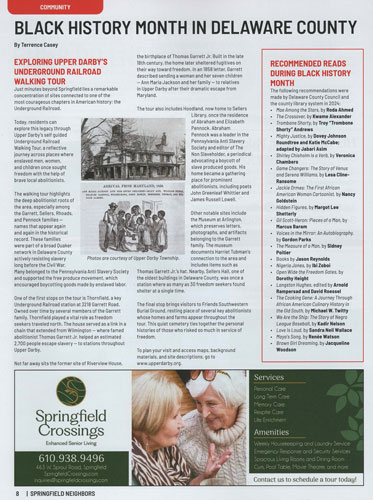
The walking tour highlights the deep abolitionist roots of the area, especially among the Garrett, Sellers, Rhoads, and Pennock families — names that appear again and again in the historical record. These families were part of a broad Quaker network in Delaware County actively resisting slavery long before the Civil War. Many belonged to the Pennsylvania Anti‑Slavery Society and supported the free‑produce movement, which encouraged boycotting goods made by enslaved labor.
One of the first stops on the tour is Thornfield, a key Underground Railroad station at 3218 Garrett Road. Owned over time by several members of the Garrett family, Thornfield played a vital role as freedom seekers traveled north. The house served as a link in a chain that extended from Wilmington — where famed abolitionist Thomas Garrett Jr. helped an estimated 2,700 people escape slavery — to stations throughout Upper Darby.
Not far away sits the former site of Riverview House, the birthplace of Thomas Garrett Jr. Built in the late 18th century, the home later sheltered fugitives on their way toward freedom. In an 1858 letter, Garrett described sending a woman and her seven children — Ann Maria Jackson and her family — to relatives in Upper Darby after their dramatic escape from Maryland.
The tour also includes Hoodland, now home to Sellers Library, once the residence of Abraham and Elizabeth Pennock. Abraham Pennock was a leader in the Pennsylvania Anti‑Slavery Society and editor of The Non‑Slaveholder, a periodical advocating a boycott of slave‑produced goods. His home became a gathering place for prominent abolitionists, including poets John Greenleaf Whittier and James Russell Lowell.
Other notable sites include the Museum at Arlington, which preserves letters, photographs, and artifacts belonging to the Garrett family. The museum documents Harriet Tubman’s connection to the area and includes items such as Thomas Garrett Jr.’s hat. Nearby, Sellers Hall, one of the oldest buildings in Delaware County, was once a station where as many as 30 freedom seekers found shelter at a single time.
The final stop brings visitors to Friends Southwestern Burial Ground, resting place of several key abolitionists whose homes and farms appear throughout the tour. This quiet cemetery ties together the personal histories of those who risked so much in service of freedom.
To plan your visit and access maps, background materials, and site descriptions, go to https://www.upperdarby.org/UndergroundRailroadWalkingTour.